WhatsApp Business API for Real Estate in India: 2026 Guide
The WhatsApp Business API allows Indian real estate developers and brokers to automate lead qualification, instantly share project brochures, and coordinate site visits at scale.
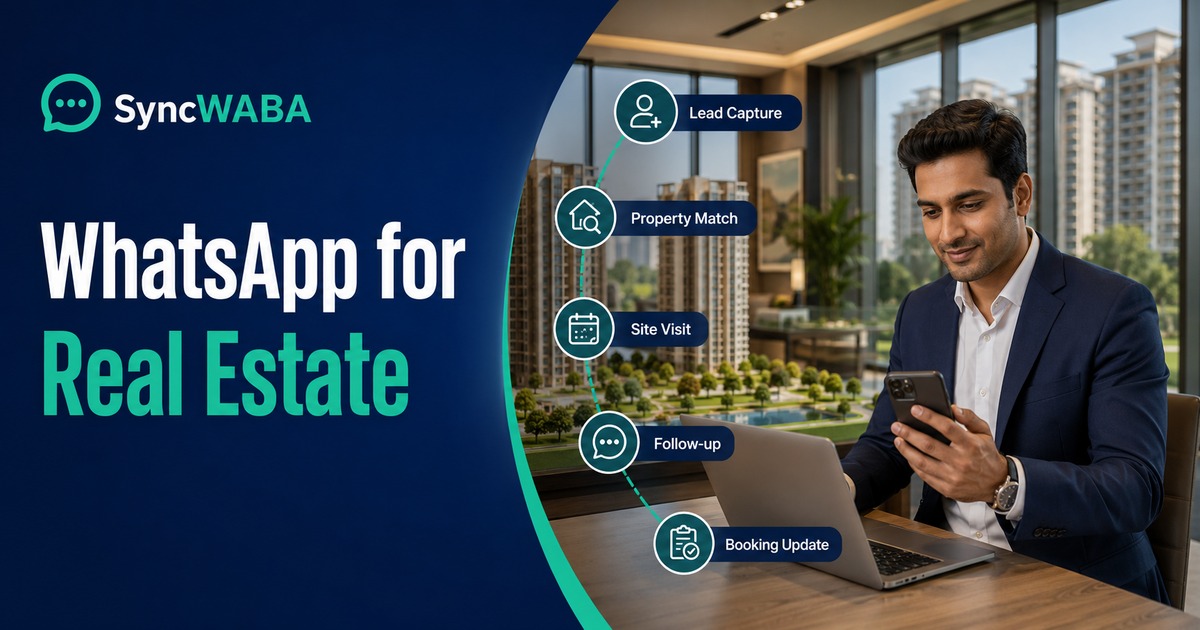
WhatsApp Business API for Real Estate in India
Lead Qualification, Site Visits, CRM Automation and ROI Guide for 2026
Property buyers in India rarely follow a neat sales funnel. A prospect may discover a project through Instagram, ask for a brochure on WhatsApp, disappear for a week, return with a location question, schedule a Sunday site visit and then involve a family member before making a decision. The lead is valuable, but the journey is fragmented.
For builders, channel partners and property consultants, the problem is not simply generating more leads. It is responding quickly, collecting useful requirements, routing each enquiry to the right salesperson, following up without becoming repetitive, coordinating site visits and keeping the CRM current.
The WhatsApp Business API for real estate can turn this scattered communication into a structured lead-management system. It gives a real-estate team a shared business channel, approved message templates, automated workflows, interactive forms, CRM integration, team routing and measurable follow-up.
This guide explains how Indian real-estate businesses can use the platform from first enquiry to booking and post-sale updates. It includes practical workflows, sample messages, compliance guidance, integration architecture, cost planning, KPIs and a 30-day implementation plan. It also shows where SyncWABA fits when a team needs WhatsApp campaigns, chatbots, Flows, a shared inbox, CRM workflows and APIs in one place.
Quick Answer: How Can Real-Estate Companies Use WhatsApp Business API?
Real-estate companies can use WhatsApp Business API to capture, qualify, assign and nurture property enquiries at scale. Common workflows include:
· Responding instantly to website, portal and click-to-WhatsApp ad leads
· Collecting budget, property type, preferred location and purchase timeline
· Matching prospects with relevant projects or inventory
· Sharing brochures, floor plans, price ranges and location links
· Assigning leads by city, project, language, budget or channel
· Scheduling and confirming site visits
· Reminding prospects before a visit and collecting reschedule requests
· Following up after a visit with a clear next action
· Routing pricing, loan, legal and technical questions to specialists
· Sending booking, document and payment-status updates
· Re-engaging opted-in leads when suitable inventory becomes available
· Recording replies, delivery status, agent ownership and lead stage in a CRM
The API is not a replacement for a CRM, property inventory system or skilled sales consultant. It is the communication layer that connects prospects with those systems and people. A strong implementation uses automation for speed and consistency while keeping human advisers available for complex decisions.
Why Real-Estate Leads Leak After Enquiry Generation
Real-estate marketing teams often focus on cost per lead. Sales teams experience a different reality: many enquiries contain incomplete information, arrive outside office hours or are distributed through spreadsheets and personal WhatsApp accounts.
Consider a residential developer running campaigns for projects in Noida, Gurugram and Faridabad. A lead generated at 9:45 p.m. receives no response until the next morning. Another lead is contacted by two agents. A third asks for a 3BHK below a specific budget but receives a generic project brochure. A fourth schedules a visit, yet nobody sends the map or confirmation. A fifth visits the site but receives no structured follow-up.
These gaps produce familiar problems:
· Slow first response during evenings and weekends
· Duplicate calls from multiple agents
· Incomplete requirement data
· Poor matching between buyer needs and available properties
· Brochures sent without context or next steps
· Follow-ups depending on individual discipline
· Site visits missed because the time or location was unclear
· Lead status remaining in an agent's private chat
· Marketing unable to connect campaign spend with qualified opportunities
· Managers unable to see ageing, ownership or next-action gaps
· Valuable old leads being contacted with irrelevant inventory
· Opt-outs not being applied consistently across campaigns
WhatsApp automation addresses these operational gaps only when the workflow has clear ownership. Sending more messages without lead discipline simply automates noise.
WhatsApp Business App vs API for Real Estate
The WhatsApp Business App may be adequate for an independent broker with a small number of active enquiries. The API becomes more useful when several agents, projects, sources and automated journeys must operate through one controlled number.
|
Capability |
WhatsApp Business App |
WhatsApp Business API with a platform |
|
Best fit |
Individual consultant or very small team |
Builders, agencies and multi-agent sales teams |
|
Lead ownership |
Mostly manual |
Assignment, queues, roles and shared visibility |
|
CRM integration |
Manual copy-paste |
API, webhook and workflow integration |
|
Qualification |
Manual questions |
Chatbot or WhatsApp Flow |
|
Site-visit scheduling |
Manual coordination |
Guided booking and automated confirmation |
|
Approved outbound messaging |
Limited app workflow |
Approved templates outside the service window |
|
Campaign targeting |
Basic lists |
Segments based on consent and lead attributes |
|
Reporting |
Limited |
Delivery, reply, assignment and campaign analytics |
|
Continuity |
Often tied to devices or individuals |
Central business history and permissions |
|
Scale |
Suitable for low volumes |
Designed for structured business messaging |
The decision should be based on process complexity, not only lead count. Even a compact brokerage may need API-based operations if it handles several projects, languages or agents and depends heavily on digital lead generation.
The Real-Estate Lead Journey to Automate
Map the full journey before building any chatbot or campaign.
|
Journey stage |
Useful WhatsApp workflow |
Primary owner |
|
Enquiry capture |
Instant acknowledgement and source tagging |
Marketing operations |
|
Qualification |
Budget, location, property type and timeline |
Inside sales |
|
Property matching |
Relevant options based on verified inventory |
Sales consultant |
|
Consultation |
Call or video-meeting scheduling |
Assigned adviser |
|
Site visit |
Slot selection, confirmation and map |
Sales coordination |
|
Visit follow-up |
Feedback, objection and next-action capture |
Sales consultant |
|
Negotiation |
Route commercial questions and approvals |
Sales manager |
|
Booking |
Confirmation and document checklist |
Booking desk |
|
Payment milestone |
Non-promotional status or due-date update |
Accounts |
|
Construction update |
Approved project milestone communication |
Customer relations |
|
Possession |
Inspection, documentation and handover coordination |
CRM team |
|
Referral |
Permission-based request after a positive outcome |
Customer success |
Automation should reduce uncertainty or request a meaningful action. Not every internal CRM stage deserves a customer message.
1. Capture Leads from Websites, Portals and Ads
Property enquiries may come from a project website, landing page, Meta campaign, Google campaign, housing portal, referral campaign, QR code, event or offline advertisement. Each source should create a lead with a source identifier and capture consent in an appropriate manner.
Ads that click to WhatsApp are especially useful when the prospect wants immediate conversation. The official WhatsApp business site states that these ads can run across Facebook and Instagram placements and open a chat with the business. The first message should establish context instead of forcing the prospect to repeat the ad they clicked.
A useful welcome sequence might:
1. Acknowledge the enquiry
2. Identify the project or campaign source
3. Ask whether the prospect is buying for self-use or investment
4. Collect preferred city or micro-market
5. Collect configuration and approximate budget
6. Ask the purchase timeline
7. Offer a brochure, call or site visit
8. Assign the lead to the appropriate consultant
Do not turn the first interaction into a lengthy application form. Capture the minimum data required to route and serve the buyer.
2. Qualify Property Enquiries with a WhatsApp Flow
WhatsApp Flows can create guided experiences inside WhatsApp. The official WhatsApp Flows page describes uses such as lead capture, appointment booking and customized customer journeys. For real estate, a Flow can replace an unstructured series of questions with a short, consistent qualification form.
Useful qualification fields include:
· Buyer name
· City or preferred locality
· Residential, commercial or plotted requirement
· Configuration such as 2BHK, 3BHK, office or shop
· Approximate budget range
· Ready-to-move or under-construction preference
· Self-use or investment intent
· Expected purchase timeline
· Home-loan assistance requirement
· Preferred language and contact time
Avoid collecting sensitive identifiers in the first interaction. The official messaging policy says businesses should not ask people to share full payment-card numbers, financial account numbers, personal ID numbers or other sensitive identifiers on WhatsApp.
After submission, the workflow can create or update a CRM lead, calculate an initial score, tag the requirement and assign an owner. The prospect should receive a clear summary and a route to correct any information.
3. Match Buyers with Relevant Inventory
Generic brochure dumping is a common failure. A prospect seeking a ready-to-move 2BHK in Noida Extension should not receive every project in Delhi NCR.
Property matching should use verified fields such as location, budget, configuration, possession preference and purpose. The system can return a small set of relevant options, each with:
· Project name and micro-market
· Available configuration
· Indicative price range with a clear qualification note
· Possession or development status
· One key differentiator
· Brochure or landing-page link
· Option to request a call or site visit
Inventory, pricing and availability must come from an authorised data source. Never let a bot invent availability or make a commercial commitment. If data is missing or old, the response should say that an adviser will confirm the current position.
For a Gurugram channel partner, a practical rule could be: if budget is ₹1.5-2.0 crore, preference is a 3BHK and timeline is below six months, show only active projects that meet all three conditions. If no exact match exists, route the lead to a consultant instead of forcing an irrelevant option.
4. Route Every Lead to the Right Consultant
Lead assignment affects conversion and customer experience. Rules may use:
· Project or developer
· Location or territory
· Residential versus commercial
· Budget range
· Language
· Lead source
· New lead versus existing customer
· Agent capacity and availability
· Channel partner or direct-sales relationship
The assigned consultant should receive the conversation context, not only a phone number. The context may include source, campaign, requirement, recent messages, documents shared and scheduled action.
A shared inbox prevents two agents from replying at once and allows a manager to reassign leads during leave or shift changes. Role-based access can limit which teams see booking or payment details.
5. Schedule and Confirm Site Visits
Site-visit coordination is an ideal automation target because it combines repetitive questions with clear business rules.
A guided site-visit workflow can:
1. Confirm the selected project
2. Offer available dates and time slots
3. Ask the number of visitors
4. Collect travel or pickup requirements if applicable
5. Confirm the meeting point
6. Share the map link and contact person
7. Create a calendar or CRM activity
8. Notify the assigned consultant
9. Send a reminder before the visit
10. Offer reschedule or cancellation options
For example, a prospect in Delhi may choose Sunday at 11:30 a.m. for a Noida project. The confirmation should include the project, date, time, map and adviser contact. A reminder can ask the buyer to confirm or reschedule with quick-reply buttons.
The workflow must handle exceptions. If the project is closed on a date, a slot is full or the consultant becomes unavailable, the system should propose alternatives and alert a human coordinator.
6. Follow Up After a Site Visit
The post-visit period is where disciplined follow-up matters most. Avoid repeated messages asking only, “Any update?” Instead, record the visit outcome and send context-aware communication.
Possible outcomes include:
· Interested and wants a cost sheet
· Comparing another project
· Needs family consultation
· Wants a different unit or floor
· Requires home-loan guidance
· Concerned about location, price or possession
· Not suitable now but open to future options
· Not interested and should be closed
A useful follow-up might offer a unit-specific cost sheet, schedule a discussion with a manager or answer a documented objection. The system must stop the sequence when the prospect replies, opts out, books, becomes unsuitable or is marked closed.
The best automation creates a next action for the sales team rather than merely sending reminders to the buyer.
7. Use Click-to-WhatsApp Campaigns with Better Attribution
The official WhatsApp page says ads that click to WhatsApp can support lead generation, sales and marketing and can be measured with Meta tracking tools. For a real-estate business, the ad-to-chat journey should preserve campaign context.
Store fields such as:
· Campaign, ad set and creative identifier
· Project or property promoted
· Landing or conversation entry point
· First-message timestamp
· Qualification completion
· Assigned owner
· Site visit booked and completed
· Opportunity stage
· Booking outcome and attributable value
This allows marketing to evaluate qualified lead cost and visit cost, not only raw conversation volume. A campaign generating fewer leads may be more valuable if those leads match the property's ticket size, location and timeline.
Meta's current pricing page also states that when a customer messages from an ad that clicks to WhatsApp or a Facebook Page call-to-action button, messages are not charged for the following 72 hours. Confirm the exact current rule before budgeting because pricing policies can change.
8. Re-Engage Old Leads Responsibly
Old CRM leads can be valuable, but possession of a phone number does not automatically provide permission for every future campaign. The official policy requires the recipient's mobile number and opt-in permission, and it requires businesses to respect opt-out requests.
Segment re-engagement by genuine relevance:
· New inventory in the requested micro-market
· Price range now matching the recorded budget
· Ready-to-move option for a previously delayed buyer
· Commercial property opportunity for an opted-in investor
· Project update requested by the lead
· Appointment or consultation follow-up requested earlier
Do not upload a large historic database and send the same offer to everyone. Confirm consent source, scope and date; suppress opt-outs; exclude already-booked or invalid records; and cap frequency.
9. Send Booking and Customer-Relationship Updates
After booking, communication shifts from sales nurturing to service and transaction support. Useful non-promotional updates may include:
· Booking acknowledgement
· Document checklist
· Application-status update
· Payment milestone reminder
· Receipt availability
· Construction milestone update
· Inspection or snagging appointment
· Registration or possession coordination
· Customer-care ticket acknowledgement
Use secure links or controlled portals for documents containing sensitive personal or financial information. WhatsApp should notify and guide; it should not become the only repository for contracts, identity documents or payment evidence.
Sample WhatsApp Templates for Real Estate
These are drafting examples. Final category depends on message purpose and current Meta guidelines. Submit the final text through the applicable approval process.
Lead acknowledgement
Hello {{1}}, thank you for your enquiry about {{2}}. To help us suggest relevant options, please share your preferred location, property type, approximate budget and purchase timeline. You can also choose “Talk to Adviser”.
Property match
Hello {{1}}, based on your requirement for {{2}} in {{3}}, we have shortlisted {{4}} relevant option(s). View the details here: {{5}}. Availability and pricing will be confirmed by your assigned adviser.
Site-visit confirmation
Your visit to {{1}} is confirmed for {{2}} at {{3}}. Meeting point: {{4}}. Map: {{5}}. Your adviser is {{6}}. Reply RESCHEDULE if you need another slot.
Site-visit reminder
Reminder: your visit to {{1}} is scheduled today at {{2}}. Please use this map: {{3}}. Reply CONFIRM, RESCHEDULE or CANCEL so our team can assist you.
Post-visit follow-up
Thank you for visiting {{1}}, {{2}}. Would you like the detailed cost sheet, a call with our property adviser, or information about another configuration? Reply with your preferred option.
Booking acknowledgement
Thank you, {{1}}. We have received your booking request for {{2}}. Reference: {{3}}. Our booking team will verify the details and update you by {{4}}. This message is an acknowledgement, not final allotment confirmation.
Document reminder
Hello {{1}}, the following item is pending for booking reference {{2}}: {{3}}. Please use the secure link {{4}} or contact your booking adviser. Do not share sensitive identification or bank details directly in chat.
New-property alert
Hello {{1}}, you asked to receive suitable property updates for {{2}}. A new option matching {{3}} is available to review: {{4}}. Reply STOP to opt out of future property alerts.
How the CRM and WhatsApp Architecture Works
A reliable setup normally has five layers:
1. Lead sources: Website forms, property portals, Meta ads, QR codes, events and referrals
2. System of record: CRM, lead-management system, project inventory or approved database
3. Business rules: Qualification, scoring, assignment, reminders, consent and stop conditions
4. Messaging layer: SyncWABA connected with the official WhatsApp Business Platform
5. Response loop: Replies, status events, agent actions and outcomes written back to the CRM
Example: a click-to-WhatsApp lead enters from an ad for a Noida project. The bot captures budget, configuration and timeline. The CRM assigns the lead to the Noida residential queue. The buyer books a visit through a Flow. SyncWABA sends confirmation and reminders. The consultant records the visit outcome. A relevant next-step template is triggered only if the buyer has not replied and the lead remains open.
This design prevents WhatsApp from becoming another disconnected inbox.
Data fields worth standardising
· Lead ID
· Source, campaign and project
· Contact name and WhatsApp number with country code
· Consent source, scope, date and opt-out status
· Preferred language
· City, micro-market and property type
· Configuration and budget range
· Self-use or investment intent
· Purchase timeline
· Assigned agent and team
· Lead stage and score
· Last meaningful interaction
· Next action and due date
· Visit date, visit status and feedback
· Booking reference where applicable
Compliance and Message Quality Rules
The official WhatsApp Business Messaging Policy should be treated as an operational requirement, not a legal footnote.
Important controls include:
· Contact people only when the number and appropriate opt-in are available
· State what categories of messages the person can expect
· Maintain simple category-specific opt-outs where practical
· Honour opt-out requests across campaigns and teams
· Use approved message templates to initiate conversations
· Reply without a template only inside the applicable 24-hour service window
· Provide a direct route to a human when automation cannot resolve the need
· Avoid misleading claims, fabricated scarcity or surprise messaging
· Do not request full card, bank-account, personal-ID or similar sensitive data
· Maintain a published privacy policy and appropriate permissions
· Protect CRM exports, documents, webhook logs and agent access
· Remove access promptly when employees or channel partners leave
Property advertising and sales claims must also comply with applicable Indian laws and project-specific requirements. Automation should never substitute for legal review of project claims, pricing disclosures, approvals or investment language.
Understanding Message Categories and Cost
As checked on 25 August 2026, the official WhatsApp pricing page describes per-message pricing based on recipient market and message category. Charges apply when a message is delivered, not merely sent. The four categories are marketing, utility, authentication and service.
For real estate:
· Marketing may include new-project launches, investment campaigns, property alerts and re-engagement offers
· Utility may include non-promotional updates tied to a specific requested transaction or customer action
· Authentication is used for eligible one-time password and identity-verification journeys
· Service covers responses to incoming customer enquiries inside the applicable customer-service window
The complete budget may include Meta message charges, the platform plan, additional agents, Flow or automation capacity, CRM integration and implementation effort. Use the live official pricing page and SyncWABA pricing page when preparing a budget.
Do not select a category merely because it is cheaper. Template category should reflect the actual purpose and content.
Measuring ROI from Real-Estate WhatsApp Automation
Do not judge the project only by message delivery or open rates. Measure how the workflow changes lead handling and sales execution.
Useful metrics include:
· Median first-response time
· Percentage of leads completing qualification
· Percentage of leads assigned within the target time
· Duplicate-contact rate
· Qualified lead rate by source and campaign
· Consultation booking rate
· Site-visit booking and completion rate
· No-show and reschedule rate
· Follow-up tasks completed on time
· Visit-to-opportunity and opportunity-to-booking conversion
· Lead ageing by stage
· Opt-out, block and complaint rate
· Agent conversations handled per day
· Revenue or contribution attributable to influenced bookings
Illustrative example: site-visit improvement
Assume a brokerage receives 1,000 digital enquiries in a month. Under a manual process, 300 are meaningfully qualified, 90 site visits are booked and 60 are completed. After implementing instant acknowledgement, guided qualification, appointment choice and reminders, 420 leads are qualified, 130 visits are booked and 95 are completed.
If the team converts 5% of completed visits into bookings, the expected number moves from three bookings to approximately five. If the average contribution per booking is ₹70,000, two additional bookings represent ₹1,40,000 in illustrative monthly contribution.
If messaging, platform and operating costs total ₹30,000 for the month, the simplified illustrative ROI is:
(₹1,40,000 - ₹30,000) / ₹30,000 × 100 = 366.7%
This is an example, not a promised result. Use actual lead quality, visit rate, contribution, cancellations and baseline data.
A 30-Day Implementation Plan
Week 1: Map one journey
Choose one project and one lead source. Document the entry point, minimum qualification fields, assignment rule, response target, site-visit process, stop conditions and success metric. Audit current numbers, templates and consent evidence.
Week 2: Prepare data and messages
Standardise project codes, locations, price ranges, inventory status, agent ownership and CRM stages. Draft templates for acknowledgement, visit confirmation, reminder and post-visit follow-up. Remove unsupported claims and promotional content from utility messages.
Week 3: Build and test
Connect the CRM or lead sheet, configure the qualification Flow, assignment rules and shared inbox. Test missing fields, duplicate leads, invalid numbers, closed slots, reassignment, opt-out and failed-message scenarios.
Week 4: Pilot and measure
Run the workflow for one project or campaign. Compare first response, qualification, visit booking, visit completion, follow-up completion and opt-out rate with the documented baseline. Interview agents and review conversations before expanding.
Common Mistakes to Avoid
Building a chatbot before fixing the lead process
If the CRM has no clear stages or ownership, the bot will create faster confusion. Define the operating process first.
Treating every portal enquiry as fully opted in
Source access and consent scope are not the same thing. Store the actual opt-in evidence and expected message categories.
Asking too many questions immediately
A long qualification form increases abandonment. Capture only what is needed for the next useful action.
Sending every brochure to every lead
Relevance matters more than volume. Use requirement fields and verified inventory.
Automating without stop conditions
Sequences should stop when the lead replies, opts out, books, closes or becomes ineligible.
Letting the bot promise inventory or discounts
Pricing, allotment, availability and commercial approvals must come from authorised data and people.
Measuring only message delivery
Connect messaging data with qualification, appointments, visits, opportunities and bookings.
Why SyncWABA Fits Real-Estate Workflows
SyncWABA combines official WhatsApp Business Platform connectivity with tools that can support a structured property-sales journey. Current capabilities displayed on SyncWABA include:
· Direct Meta Cloud API integration
· Real-time message status tracking and webhooks
· Rich-media and document handling
· Campaign scheduling, filtering and template synchronisation
· Visual chatbot and WhatsApp Flow design
· Conditional routing and automated follow-up sequences
· Integrated CRM contact management
· Shared team inbox with permissions
· Ads-to-WhatsApp conversion tracking
· API integration with external CRMs and systems
· Campaign and interaction analytics
A real-estate company can begin with one high-value workflow such as ad-lead qualification or site-visit scheduling, measure the result and then expand to post-visit follow-up, booking communication and customer updates.
Start Free with SyncWABA to test a focused workflow, or Book a Demo for a real-estate use-case review involving lead sources, CRM, assignment, visits and campaign tracking.
Frequently Asked Questions
Is WhatsApp Business API useful for individual property consultants?
It can be, especially when the consultant generates many digital leads or needs automated qualification and reminders. A low-volume consultant may remain comfortable with the Business App, while a growing team usually benefits more from shared ownership and CRM integration.
Can WhatsApp automatically qualify real-estate leads?
Yes. A chatbot or WhatsApp Flow can collect location, configuration, budget, intent and timeline. The result should be written to a CRM and routed to a human adviser for property-specific guidance.
Can buyers book site visits inside WhatsApp?
Yes. A guided Flow can offer approved slots, capture visitor details and confirm the meeting. The scheduling system should prevent double booking and support rescheduling and cancellation.
Can we share brochures, floor plans and price sheets?
The platform supports rich media and documents. Share only current, approved material and use secure links for sensitive or personalised documents. Clearly qualify indicative pricing and availability.
Can we integrate WhatsApp with our real-estate CRM?
Yes, when the CRM supports an API, webhook, middleware or another controlled integration. SyncWABA can operate as the messaging layer while the CRM remains the system of record.
Do click-to-WhatsApp ads work for property leads?
They can open an immediate WhatsApp conversation from Facebook or Instagram. Performance depends on creative, targeting, project-market fit, qualification and sales follow-up. Measure qualified leads, visits and bookings rather than chat volume alone.
Can we message every lead purchased from a portal or database?
Do not assume that having a number equals permission for broad WhatsApp marketing. Confirm how the person opted in, what messages were expected and whether the consent is valid for the intended campaign.
What happens when a prospect replies?
The conversation can route to an assigned adviser, bot or team queue. Under current official rules, a user message opens a 24-hour customer-service window that resets with each new user message.
Are site-visit reminders utility messages?
They may qualify as utility when they are non-promotional and tied to a specific appointment requested by the user. Final classification depends on the content and current category guidance.
How quickly can a real-estate workflow be launched?
A focused pilot can often be designed and tested in a few weeks. Complex CRM integration, multiple projects, inventory mapping, languages, approvals and data cleaning can extend the timeline.
Which workflow should a developer automate first?
Choose a journey with high volume, reliable data, a clear trigger and measurable leakage. Digital-lead qualification and site-visit scheduling are strong starting points for many teams.
How should success be measured?
Track first response, qualification completion, assignment, site-visit booking and completion, follow-up completion, conversion, lead ageing and opt-outs against a documented baseline.
Final Thoughts
WhatsApp already sits inside the Indian property-buying journey. The opportunity is to stop treating it as a collection of private chats and build it as a governed sales and service channel.
The most effective real-estate automation does four things: responds quickly, captures useful requirements, keeps ownership visible and creates a clear next action. It does not replace trust, local knowledge, negotiation or human advice. It gives those strengths a more reliable operating system.
Start with one project, one source and one measurable workflow. Build consent, human escalation and stop conditions into the design. Connect only the data required for the customer action. Expand after the pilot improves lead qualification, site visits or follow-up performance.
Ready to build a structured WhatsApp journey for property enquiries, site visits and bookings?
Start Your Free Trial or Book a Real-Estate Automation Demo with SyncWABA.
Tags:
Ready to Get Started with WhatsApp Business API?
Join 1,000+ businesses using SyncWABA to grow with WhatsApp. Start free today!