WhatsApp Marketing for Retail Stores: 10 Strategies to Turn Chats Into Sales
Boost your retail sales with these 10 powerful WhatsApp marketing strategies. Learn how to engage customers, promote products, automate conversations, increase repeat purchases, and turn WhatsApp chats into loyal customers and higher revenue with WhatsApp Busines
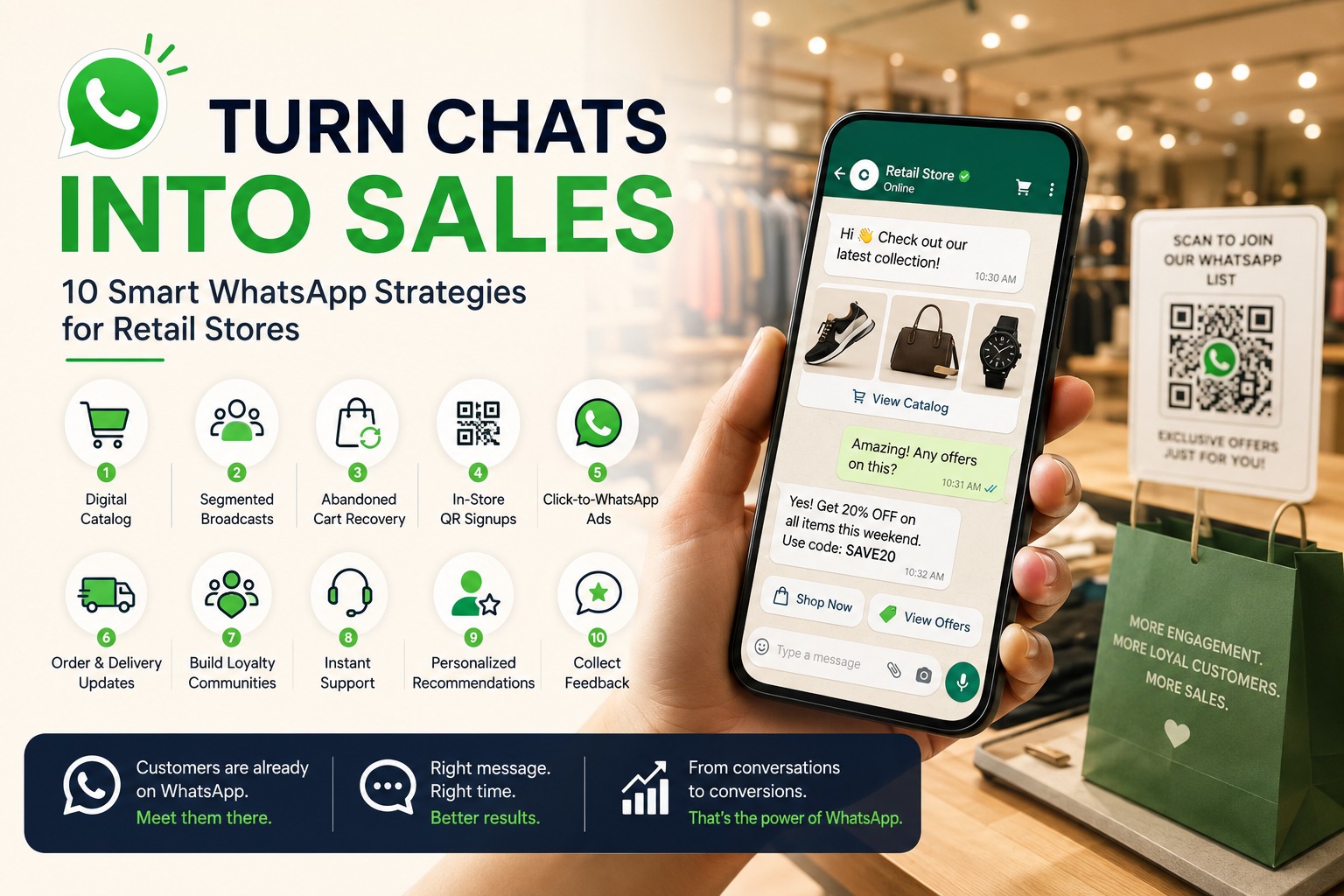
WhatsApp Marketing for Retail Stores: 10 Strategies to Turn Chats Into Sales
Most retail stores already have a WhatsApp number the question is whether it's being used as a marketing channel or just a place customers occasionally send a question. The difference between the two is significant. A retail business using WhatsApp deliberately can turn it into a digital storefront, a promotions channel, and a support line all at once, inside an app most customers already check multiple times a day.
This article walks through ten practical strategies retail stores use to turn WhatsApp conversations into actual sales, along with what's required to run each one properly.
Why Retail Stores Are Prioritizing WhatsApp
Retail marketing has traditionally leaned on email, SMS, and paid social channels that are increasingly crowded or ignored. Email gets lost in crowded inboxes, and SMS is often limited by character count and low engagement. WhatsApp sits in a different position: customers tend to check it frequently throughout the day, and a well-crafted message with an image, a product catalog, or a quick-reply button feels closer to a real conversation than a broadcast.
That said, WhatsApp's relevance does vary by region and audience it's a dominant, near-default channel in markets like India and much of the Middle East, while adoption is comparatively lower in markets like the US, where other messaging apps are more common. Retail stores should weigh WhatsApp marketing against where their actual customer base is most active, rather than assuming universal relevance.
10 Strategies for Retail WhatsApp Marketing
1. Build a Real Digital Storefront With a Catalog
The WhatsApp Business Catalog lets a store display products with photos, prices, and descriptions directly inside the app, so customers can browse without leaving the chat or visiting a website. For a retail brand, this effectively becomes a lightweight digital storefront — worth treating with the same care as a website product page, not as an afterthought.
2. Segment Broadcasts Instead of Blasting Everyone
A generic “sale this weekend” message to an entire contact list tends to underperform compared to a segmented one sent only to customers who've shown interest in a specific category, price range, or past purchase. Segmentation requires tagging contacts and organizing them by behavior, which is where a proper WhatsApp API platform with CRM and tagging capability matters more than the free Business App.
3. Recover Abandoned Carts Automatically
For retail stores selling online, a templated reminder sent shortly after a cart is abandoned recovers a meaningful share of otherwise lost sales. This requires integration between the store's e-commerce platform and the WhatsApp API so the trigger fires automatically rather than relying on manual follow-up.
4. Turn In-Store Visits Into a Messaging List
A QR code at checkout, on a receipt, or on a table (for a café or restaurant-style retail setup) lets in-person customers opt into WhatsApp updates with a single scan. This converts physical foot traffic into a channel the store can re-engage later, rather than a one-time transaction with no further contact.
5. Use Click-to-WhatsApp Ads to Skip the Landing Page
Instead of sending paid social traffic to a landing page that a customer may abandon, a click-to-WhatsApp ad opens directly into a chat letting the customer ask a question or get product details immediately, in a format that often converts better than a cold landing page for many retail categories.
6. Send Order and Delivery Updates Proactively
Order confirmations, shipping updates, and delivery notifications sent automatically reduce the number of customers who message in just to ask “where's my order,” while also building trust through consistent, timely communication.
7. Build Loyalty Through Community, Not Just Discounts
Some retail brands use WhatsApp groups or broadcast lists organized by interest for example, a bookstore running genre-based communities that share recommendations relevant to each group, rather than one undifferentiated promotional list. This tends to build stronger repeat engagement than discount-only messaging.
8. Offer Support Without Making Customers Wait
A chatbot that can answer common questions store hours, return policy, stock availability keeps support responsive outside business hours, while routing anything more complex to a human agent through a shared inbox.
9. Personalize Based on Purchase History
With contact tagging and a connected CRM, a retail store can send recommendations based on what a customer has actually bought before, rather than generic catalog blasts closer to how a good in-store sales associate would operate, just automated.
10. Collect Feedback Right After Purchase
A short, templated feedback message sent shortly after a purchase or store visit tends to get a notably higher response rate than the same survey sent by email, simply because it appears where the customer is already looking.
Quick Reference: Strategy to Outcome
|
Strategy |
What It Solves |
Example |
|
Digital catalog |
Customers browsing without visiting the store or website |
A boutique shares its new arrivals as a browsable WhatsApp catalog |
|
Segmented broadcasts |
Generic promotions getting ignored |
A footwear store sends a sale alert only to customers who browsed sneakers |
|
Cart recovery |
Customers adding items but not completing checkout |
A reminder message sent an hour after an abandoned cart |
|
In-store QR codes |
Turning physical foot traffic into a messaging list |
A café displays a QR code for loyalty updates and offers |
|
Click-to-WhatsApp ads |
Ad clicks that don't convert on a landing page |
An Instagram ad opens directly into a WhatsApp chat with product info |
WhatsApp Business App vs API for Retail Marketing
The free WhatsApp Business App can support a very small retail operation a single owner sharing a catalog and replying to a handful of chats a day. The moment a retail store wants segmented broadcasts, automated cart recovery, multiple staff replying from one number, or any kind of chatbot, it needs the official WhatsApp Business API, accessed through a Business Solution Provider. Bulk or promotional messaging through the free app also risks the number being restricted, since the app isn't built for that kind of volume.
A Typical Scenario
Consider a mid-sized apparel retailer running both a physical store and an online shop. Previously, promotions went out over email with modest open rates, and in-store customers had no ongoing channel back to the brand after checkout. After setting up WhatsApp marketing, in-store QR codes at checkout build an opt-in list, segmented broadcasts promote new arrivals only to customers who've shown interest in similar categories, and an automated cart recovery flow follows up on abandoned online carts. Support questions about sizing and returns are handled by a chatbot during off-hours, with a human agent stepping in during the day for anything more specific.
The retailer doesn't need every strategy running at once to see a difference most retail brands start with a catalog and segmented broadcasts, then add cart recovery and support automation once the first two are working reliably.
Frequently Asked Questions
Is WhatsApp marketing effective for small retail stores?
Yes, particularly for stores with a loyal or repeat customer base. Even a simple setup a catalog and occasional segmented promotions can outperform generic email marketing for engagement, since customers tend to check WhatsApp far more frequently than their inbox.
Do I need the WhatsApp Business API, or is the free app enough for retail marketing?
The free Business App works for a very small operation with minimal message volume and a single person managing chats. Once a store wants segmented promotions, automated cart recovery, multiple staff on one number, or a chatbot, the official WhatsApp Business API becomes necessary.
Can customers actually buy products directly through WhatsApp?
Yes, through the WhatsApp catalog and cart features, customers can browse products, add items to a cart, and in supported setups complete a purchase without leaving the chat, which reduces friction compared to redirecting them to a separate website.
How does WhatsApp cart recovery work for retail?
When integrated with a store's e-commerce platform, a templated reminder message can be triggered automatically shortly after a customer abandons their cart, prompting them to complete the purchase without requiring manual follow-up from staff.
Is WhatsApp marketing relevant for retail stores in every country?
Relevance varies significantly by region. WhatsApp is a dominant communication channel in markets like India and much of the Middle East, while adoption is comparatively lower in markets like the United States, where other messaging apps are more common. It's worth evaluating based on where your specific customer base is most active.
Can I send promotional messages to my entire customer list on WhatsApp?
You can, but only to contacts who have opted in, and only through Meta-approved marketing templates. Segmenting your list by interest or purchase history rather than broadcasting to everyone tends to produce better engagement and protects your number's quality rating.
What's the benefit of using a QR code for WhatsApp marketing in a physical store?
A QR code at checkout or on a receipt lets in-person customers opt into WhatsApp updates with a single scan, turning a one-time in-store visit into an ongoing channel the retailer can use for future promotions and updates.
How can a chatbot help a retail store's WhatsApp channel?
A chatbot can handle common questions store hours, stock availability, return policy automatically and outside business hours, freeing staff to focus on questions that need a human, while still routing complex queries to a person when needed.
Does WhatsApp marketing work well for both online and physical retail stores?
Yes, though the strategies differ slightly. Online retailers benefit most from cart recovery and order updates, while physical stores benefit more from QR-code-driven opt-ins and in-store promotions, and many retailers with both channels use a combination of both approaches.
How do I avoid my retail WhatsApp number getting restricted for sending promotions?
Use only Meta-approved marketing templates, message only contacts who've explicitly opted in, and avoid sending irrelevant or excessive broadcasts, since a high block or report rate from recipients can lower your number's quality rating and restrict how many people you can message.
Start Turning Conversations Into Sales
Every strategy covered here catalog, segmented campaigns, cart recovery, chatbot support, and CRM-based personalization is available as part of the SyncWABA platform.
Book a demo to see how it fits your store's specific mix of online and in-person sales, or start a free trial to set up your first catalog and campaign.
Tags:
Ready to Get Started with WhatsApp Business API?
Join 1,000+ businesses using SyncWABA to grow with WhatsApp. Start free today!