WhatsApp Service Message Pricing 2026 Explained [New Update]
Meta will start charging WhatsApp service messages from October 1, 2026, with 1,000 free service messages per business phone number each month. Learn what changes, who pays, and how Meta Business Agent pricing is different.
![WhatsApp Service Message Pricing 2026 Explained [New Update]](https://d21q69tn3ileb8.cloudfront.net/syncwaba/1788598395888-1788598395888-whatsapp.png)
Quick answer
Meta is changing the way WhatsApp non-template messages are charged. From October 1, 2026 at 12:00 AM in the WhatsApp Business Account’s timezone, Meta will charge businesses for service messages on a per-message basis. At the same time, Meta is introducing a free monthly tier of 1,000 service messages per business phone number. That means a business phone number can receive the first 1,000 delivered service messages each month without a service-message charge, but after the 1,000th free service message, Meta will charge for further delivered service messages.[2]
Key notes for businesses
| Key point | What it means |
|---|---|
| 1,000 free service messages | Every business phone number gets 1,000 free service messages per month.[2] |
| Service-message charging starts October 1, 2026 | After the free tier, service messages become chargeable from the 1,001st delivered service message each month. |
| Approx. service-message cost | Based on the notice/context discussed here, businesses should plan around roughly ₹0.15 per delivered service message after the free tier. Actual billing can vary by market, currency, taxes, and Meta rate-card updates. |
| No payment method = delivery risk | If no payment method is added in Billing Hub, Meta’s email says the first 1,000 service messages may deliver, but messages from the 1,001st service message onward may not deliver. |
| Meta Business Agent is separate | If the message is powered by Meta Business Agent, Meta charges it as a Meta Business Agent message, not as a normal service message.[1] |
| No double charge for Meta Business Agent | Meta says a non-template message is charged either as a Meta Business Agent message or as a service message, never both.[1] |
| Meta Business Agent estimated cost | Meta says Meta Business Agent messages typically cost around 4–5 cents USD per message, which is approximately ₹3.78–₹4.73 per message at the USD-INR rate used for this estimate.[1] |
WhatsApp service messages are free only up to 1,000 delivered service messages per business phone number per month. From October 1, 2026, service messages after the free tier become chargeable, and businesses without a payment method risk non-delivery after the 1,000-message limit.[2]
Meta Business Agent messages are treated differently from normal service messages. Meta says only one category applies per non-template message: either Meta Business Agent or Service. Therefore, when Meta Business Agent powers the reply, the Meta Business Agent charge applies and the normal service-message charge does not apply separately.[1]
The important operational warning is this: if a business does not add a payment method in Meta Billing Hub, Meta’s email says it will still deliver the first 1,000 service messages each month, but it will not deliver from the 1,001st service message onward. In other words, this is not only a pricing update; it is also a delivery-continuity issue for businesses that rely on WhatsApp for customer support, lead follow-up, sales conversations, order updates, and post-purchase communication.
What Meta’s email is saying
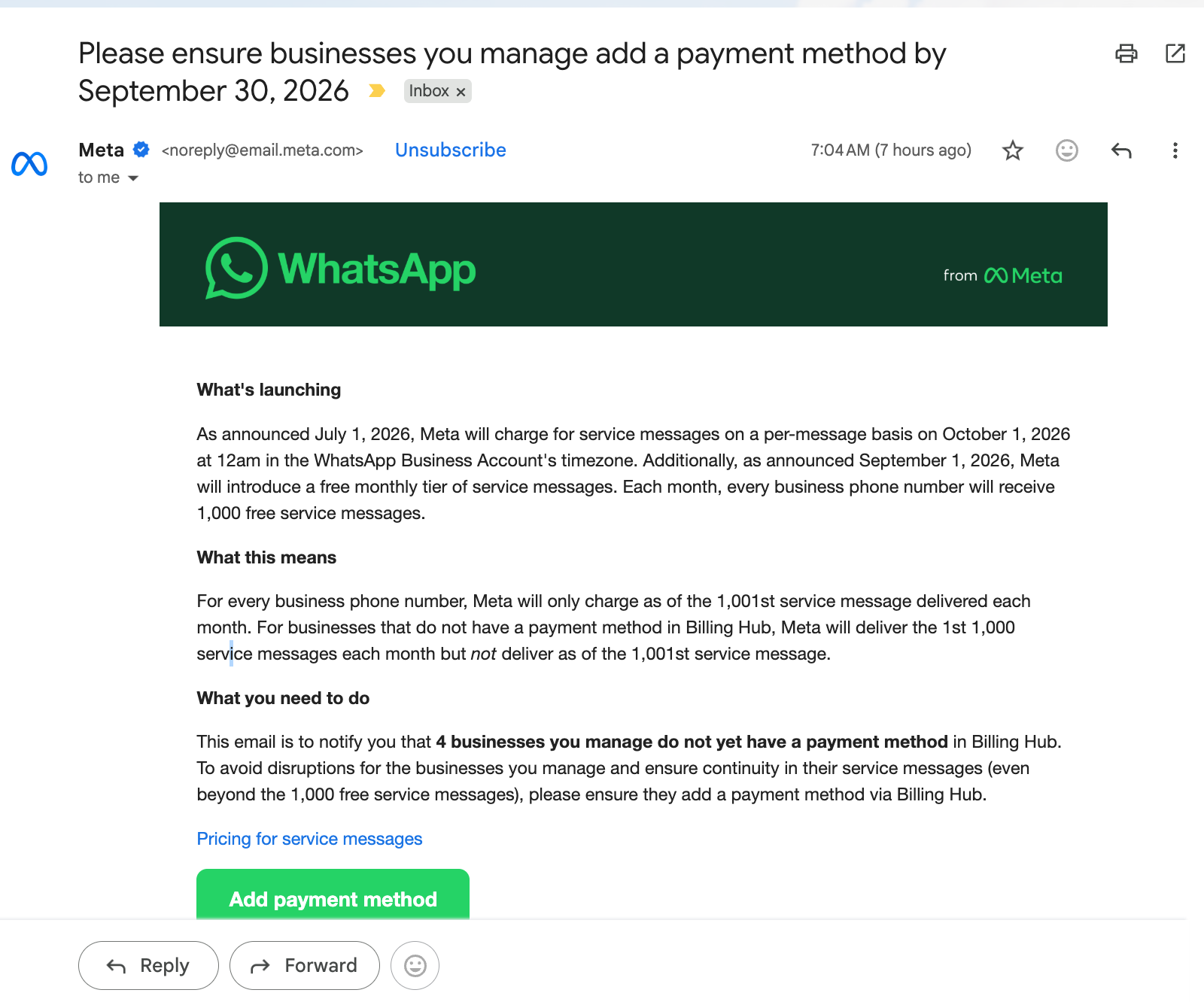
Meta’s email subject is clear: “Please ensure businesses you manage add a payment method by September 30, 2026.” The message is addressed from Meta and is specifically about WhatsApp service-message pricing. The email says Meta will start charging service messages on a per-message basis from October 1, 2026, and every business phone number will get 1,000 free service messages per month.
The most important part is under “What this means.” Meta says it will charge only from the 1,001st service message delivered each month. For businesses without a payment method in Billing Hub, Meta will deliver the first 1,000 service messages each month, but will not deliver as of the 1,001st service message.
The email also says that 4 businesses you manage do not yet have a payment method in Billing Hub. That line matters because many agencies, WhatsApp BSPs, CRM consultants, and automation providers manage multiple client WhatsApp Business Accounts. If any managed business crosses the free tier without a valid payment method, their WhatsApp service replies may stop being delivered.
This is why the update should not be treated as “just another Meta pricing email.” For businesses using WhatsApp as a sales or service channel, a missed payment setup can directly affect customer conversations.
What are WhatsApp service messages?
A service message is a non-template message sent by a business inside an open WhatsApp customer service window. Meta explains that non-template messages can only be sent in an open 24-hour customer service window, which opens and resets when a user sends a message to the business.[1]
In simple terms:
- A user sends your business a WhatsApp message.
- That user message opens or resets the 24-hour customer service window.
- During that window, your business can respond with non-template messages.
- Those non-template replies may be categorized as service messages unless they are powered by Meta Business Agent.[1]
Service messages can be handled by a human customer support representative, a sales team member, a CRM workflow, or a third-party AI automation solution. Meta’s page says service messages can be powered by a person, like a customer service representative, or by a third-party AI solution.[1]
That means if you are using a normal WhatsApp Business API inbox, a shared team inbox, GoHighLevel workflows, a third-party chatbot, or a custom AI system that is not Meta Business Agent, your non-template responses will generally fall under the service-message category.
The new 1,000 free service-message tier
Meta’s pricing update introduces one major relief for businesses: each business phone number receives 1,000 free service messages every month.[2]
This is per business phone number, not necessarily per WhatsApp Business Account. So if a business has multiple connected WhatsApp phone numbers, the free tier should be understood at the phone-number level, based on Meta’s wording.
Here is the simplified model:
| Monthly delivered service messages per business phone number | Meta service-message charge |
|---|---|
| 1 to 1,000 | Free service-message tier |
| 1,001 and above | Charged per delivered service message |
| No payment method after 1,000 | Further service messages may not be delivered |
Low-volume businesses may stay inside the free tier, but agencies and growing teams should still add payment methods before the deadline instead of waiting for usage to cross 1,000 messages.
What happens if you do not add a payment method?
Based on the email, Meta is giving a clear notice: businesses that do not have a payment method in Billing Hub can still use the first 1,000 free service messages each month, but messages after that may stop being delivered.
This creates a hidden risk. The WhatsApp bot, CRM, or support inbox may continue sending messages from your side, but Meta may not deliver those messages after the free tier is exhausted. If your team is not monitoring delivery status webhooks, it may look like customers are ignoring you, when the real issue is delivery blockage due to missing billing setup.
For sales and support teams, this can create hidden revenue leakage and customer-experience issues. The deadline is therefore about continuity, not only billing.
WhatsApp service messages vs Meta Business Agent messages
One of the biggest sources of confusion is the difference between normal service messages and Meta Business Agent messages.
Meta says that with the launch of Meta Business Agent, non-template messages can be one of two categories: Service or Meta Business Agent.[1]
Here is the practical difference:
| Message type | What powers it | How Meta categorizes it | Charging logic |
|---|---|---|---|
| Service message | Human agent, support team, CRM workflow, or third-party AI | Service | Per-message service charge after free tier |
| Meta Business Agent message | Meta Business Agent Platform | Meta Business Agent | Token-based Meta Business Agent charge |
| Template message | Pre-approved WhatsApp template | Marketing, utility, authentication, etc. | Template category pricing |
The key point: Meta says only one charge applies per message. A non-template message is charged either as a Meta Business Agent message or as a service message, never both.[1]
So businesses should not assume Meta Business Agent replies will first consume the 1,000 free service-message tier and then become service-message charged. Based on Meta’s wording, Meta Business Agent is its own category and has its own pricing model.[1]
Does Meta Business Agent also pay service-message delivery charges?
Meta’s documentation says Meta Business Agent has one token-based charge that encompasses both AI agent processing and message delivery.[1]
Meta is therefore not presenting this as “service-message delivery charge plus Meta AI processing charge.” It presents Meta Business Agent as a single charge category, which matters when comparing Meta’s AI cost with third-party AI plus WhatsApp delivery cost.
For a third-party AI solution, the business may pay the third-party AI provider or chatbot platform separately, and then pay Meta for message delivery/service messages. Meta notes that businesses using a third-party AI solution typically incur separate charges for AI usage from the AI provider and message delivery from the messaging solution provider.[1]
For Meta Business Agent, Meta combines AI processing and message delivery into one Meta Business Agent charge.[1]
How much does Meta Business Agent cost?
Meta’s documentation says the Meta Business Agent rate is $2.00 USD per 1 million tokens. It also says one message typically consumes 20,000–25,000 tokens, which translates to approximately 4–5 cents USD per message.[1]
For Indian businesses, that can feel expensive. At an approximate USD-INR conversion level, 4–5 cents can become roughly ₹3.5–₹5 per message, depending on the exchange rate. If a lead has a long AI conversation with five AI replies, that one conversation can cost around ₹18–₹25 in AI-message cost alone.
Here is a simplified example:
| Meta Business Agent replies | Approx. USD cost at 4–5 cents/message | Approx. INR range |
|---|---|---|
| 1 reply | $0.04–$0.05 | Around ₹4–₹5 |
| 5 replies | $0.20–$0.25 | Around ₹18–₹25 |
| 100 replies | $4–$5 | Around ₹350–₹500 |
| 1,000 replies | $40–$50 | Around ₹3,500–₹5,000 |
This does not make Meta Business Agent bad; it means AI should be reserved for replies where personalization creates value, not every basic response.
What charges apply in common WhatsApp scenarios?
To make the pricing easier to understand, here are typical business situations.
| Scenario | Likely message category | What to watch |
|---|---|---|
| Customer asks a question and human support replies within 24 hours | Service | First 1,000 service messages free per phone/month; after that service charges apply |
| Customer asks a question and third-party AI replies within 24 hours | Service | Third-party AI cost may be separate from Meta service-message delivery cost |
| Customer asks a question and Meta Business Agent replies | Meta Business Agent | Meta Business Agent charge applies; not service + Meta Business Agent together |
| Business sends pre-approved webinar reminder | Template | Charged according to template category, not service message |
| User comes from Click-to-WhatsApp ad and business responds inside free entry point window | Depends on category | Meta says FEP remains free for message delivery, but Meta Business Agent token usage is still charged after its effective date.[1] |
| Business has no payment method and crosses 1,000 service messages | Service | Messages after 1,000 may not be delivered |
This table is the core business takeaway: your cost depends not just on WhatsApp volume, but on the message category and what powers the reply.
Why Meta is giving this notice now
Meta is effectively asking businesses to prepare before service-message charging begins. The email tells managed businesses to add a payment method by September 30, 2026. The charging begins on October 1, 2026.
This notice period gives businesses time to add payment methods, estimate monthly service-message volume, classify messages correctly, monitor delivery webhooks, and inform managed clients. For agencies and BSPs, the deadline is more urgent because one unmanaged client account can face delivery disruption after crossing the free tier.
What businesses should do before September 30, 2026
Businesses should treat this as a readiness checklist, not just a billing task.
| Action | Why it matters | Priority |
|---|---|---|
| Add payment method in Meta Billing Hub | Prevents service-message delivery disruption after 1,000 messages | Critical |
| Check monthly service-message volume per phone number | Helps estimate whether charges will apply | Critical |
| Separate template, service, and AI replies in reporting | Prevents wrong cost assumptions | High |
| Review chatbot and CRM workflows | Some “free replies” may become chargeable service messages | High |
| Use fixed replies for simple FAQs | Avoids unnecessary AI costs | Medium |
| Use Meta Business Agent only for high-value conversations | Controls ₹ per message cost | Medium |
| Monitor delivery webhooks | Detects undelivered messages quickly | High |
| Inform managed clients | Prevents surprise billing or support disruption | Critical for agencies |
A business that uses WhatsApp lightly may only need to add a payment method and monitor usage. A business running high-volume lead generation, webinar reminders, support automation, or e-commerce follow-up should do deeper cost modeling.
Recommended cost-control strategy for India
For Indian businesses, the right strategy is usually not “AI for every message.” A better model is a hybrid WhatsApp automation system:
- Use templates for outbound reminders and notifications. Webinar reminders, payment links, appointment confirmations, delivery updates, and reactivation campaigns should usually use approved templates.
- Use service messages for normal customer replies. If users ask simple questions, service messages or fixed replies can handle them efficiently.
- Use rule-based automation for repetitive questions. Timing, pricing, registration links, brochure links, refund policy, and address details do not need AI every time.
- Use AI only for complex or high-intent conversations. AI is useful when the user asks a nuanced question, gives business context, compares options, raises objections, or needs personalized recommendation.
- Escalate quickly to human or application form. After one or two AI replies, move high-intent leads toward a call, form, payment page, or human closer.
Final takeaway
Meta’s update has three practical messages for WhatsApp Business API users.
First, service messages are becoming chargeable from October 1, 2026, but every business phone number gets 1,000 free service messages per month.[2]
Second, a payment method is required for continuity beyond the free tier. If a business does not add a payment method, Meta’s email says it will deliver the first 1,000 service messages each month but not deliver from the 1,001st service message onward.
Third, Meta Business Agent is not the same as a normal service message. If a message is powered by Meta Business Agent, it is charged as a Meta Business Agent message. If it is not powered by Meta Business Agent, it is charged as a service message. Meta says only one charge applies per message.[1]
For most businesses, the smartest move is simple: add the Billing Hub payment method before September 30, 2026, audit WhatsApp message volume, separate service/template/AI categories, and avoid using AI for every small reply. Use automation for repeatable flows, use humans for sensitive conversations, and use AI only where personalization can create revenue or reduce meaningful support workload.
FAQ
1. When will Meta start charging WhatsApp service messages?
Meta’s email says service-message charging starts on October 1, 2026 at 12:00 AM in the WhatsApp Business Account’s timezone. Meta’s pricing documentation also lists service-message charging as effective October 1, 2026.[1][2]
2. How many WhatsApp service messages are free each month?
Meta says each business phone number will receive 1,000 free service messages per month.[2]
3. What happens after 1,000 free service messages?
After 1,000 delivered service messages in a month, Meta will charge service messages on a per-message basis if a payment method exists. If no payment method exists, Meta’s email says messages from the 1,001st service message may not be delivered.
4. Does Meta Business Agent also incur service-message charges?
Meta says a non-template message is charged either as a Meta Business Agent message or as a service message, never both.[1]
5. Is third-party AI the same as Meta Business Agent?
No. Meta says service messages can be powered by a person or a third-party AI solution. Meta Business Agent messages are specifically powered by Meta Business Agent Platform.[1]
6. Should Indian businesses use Meta Business Agent for every WhatsApp reply?
Usually no. At roughly 4–5 cents USD per message, Meta Business Agent can become expensive for high-volume conversations.[1] It is better to use fixed automation for simple replies and reserve AI for high-intent or complex conversations
7. Are WhatsApp service messages free after October 1, 2026?
WhatsApp service messages are not fully free after October 1, 2026. Meta is introducing a free monthly tier of 1,000 service messages per business phone number. After the first 1,000 delivered service messages in a month, service-message charges apply if the business has a payment method. If the business does not have a payment method, Meta’s email says service messages after the 1,000th may not be delivered.
8. Is Meta Business Agent charged separately from service messages?
Meta Business Agent messages are a separate non-template message category. Meta says a non-template message is charged either as a Meta Business Agent message or as a service message, never both.[1] Meta Business Agent pricing uses one token-based charge that includes both AI processing and message delivery.
8. Is Meta Business Agent charged separately from service messages?
Meta Business Agent messages are a separate non-template message category. Meta says a non-template message is charged either as a Meta Business Agent message or as a service message, never both.[1] Meta Business Agent pricing uses one token-based charge that includes both AI processing and message delivery.
Want lower-cost WhatsApp AI automation?
If you want to automate WhatsApp customer queries without paying Meta Business Agent pricing for every AI-generated reply, you can use a custom WhatsApp AI agent with structured automations, smart flows, and human handoff. This approach can reduce WhatsApp AI agent cost because simple questions are handled by fixed workflows, buttons, templates, and rule-based replies, while AI is reserved for complex conversations where personalization is actually needed.
With SyncWABA, businesses can build WhatsApp automation flows for common queries such as pricing, webinar registration, product details, appointment booking, lead qualification, support routing, order updates, and follow-up reminders. Instead of using AI for every message, the assistant can first identify the user’s intent, trigger the right automation, answer repetitive FAQs, collect details, and escalate only high-value or unclear conversations to a custom AI agent or human team member.
InfoTechBrains provides custom WhatsApp AI agents and automation flows designed to be more cost-efficient than using Meta Business Agent for every response. If your goal is to lower AI reply cost, automate customer queries, and add a WhatsApp assistant for sales or support, sign up for SyncWABA and ask for AI Agent support. Our team can help you plan the right mix of templates, service-message flows, custom AI replies, CRM actions, and human handoff so your WhatsApp automation stays practical, scalable, and cost-controlled.
Sign up for SyncWABA and ask for AI Agent support to build a lower-cost WhatsApp AI assistant for your business.
Signup Here: https://app.syncwaba.com
Email: [email protected]
For WhatsApp AI Agent
Sources
[1] https://developers.facebook.com/documentation/business-messaging/whatsapp/pricing/non-template-messages — Meta: Upcoming pricing updates for Meta Business Agent, service and utility messages
[2] https://developers.facebook.com/docs/whatsapp/pricing/ — Meta: WhatsApp Business Platform pricing
Ready to Get Started with WhatsApp Business API?
Join 1,000+ businesses using SyncWABA to grow with WhatsApp. Start free today!