Latest WhatsApp Business Updates (2026-2027): What's New
The latest 2026 WhatsApp Business updates introduce number co-existence between the mobile app and Cloud API, expanded AI automation tools, and regional platform pricing adjustments.
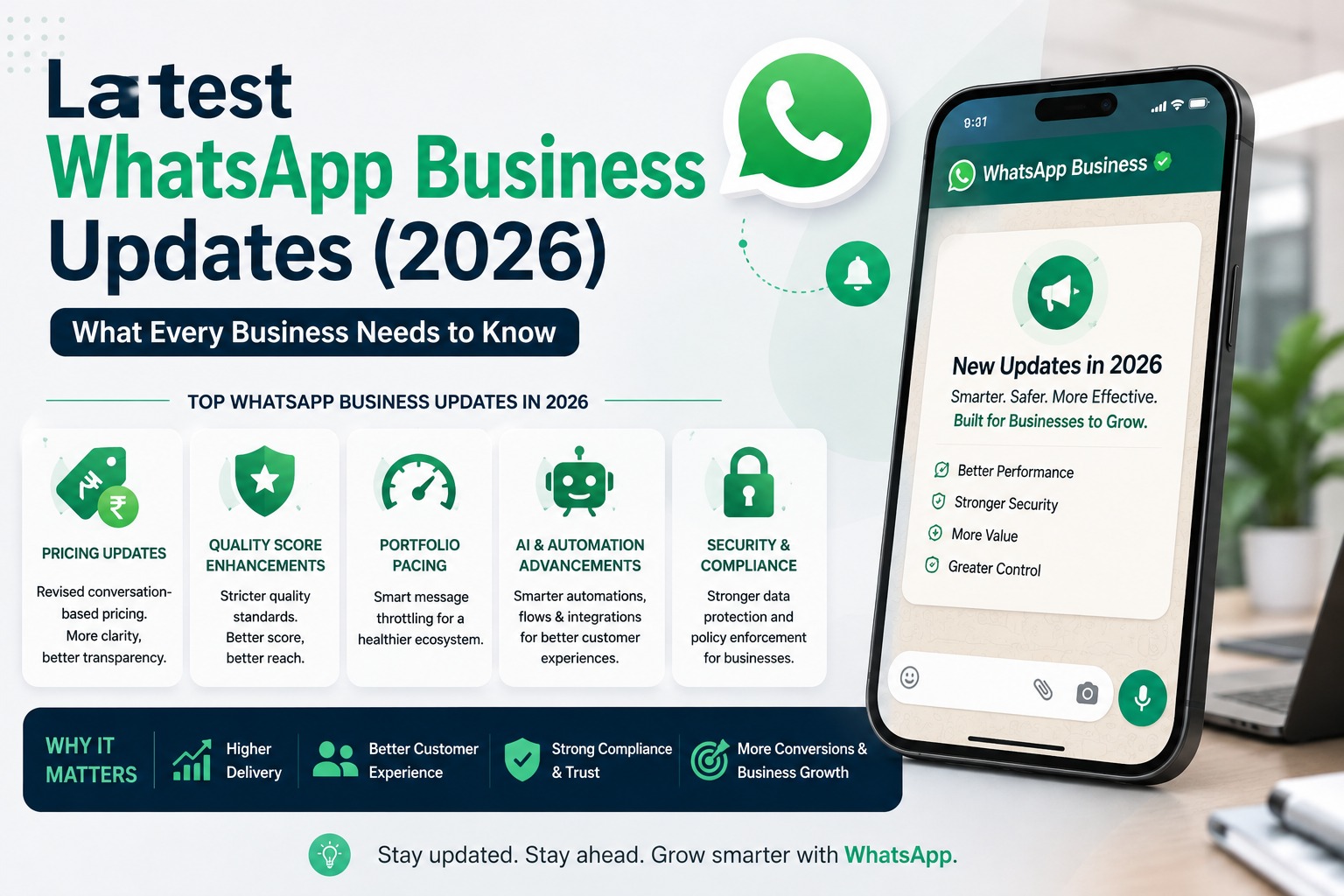
Latest WhatsApp Business Updates (2026)
What Every Business Needs to Know
Introduction
Meta doesn't run WhatsApp Business API updates on an annual release cycle changes roll out through the year, sometimes with a formal announcement, sometimes quietly through changelogs that most businesses never read until something breaks. 2026 has been an unusually active year on that front, with changes touching pricing, messaging limits, quality enforcement, and even how businesses will eventually identify customers.
This guide rounds up the WhatsApp Business updates that actually matter for businesses running on the platform in 2026 what changed, why Meta made the change, and what you should actually do about it. Since Meta ships updates on a rolling basis, treat this as a snapshot rather than a permanently fixed list, and pair it with our pricing guide for the latest rate specifics.
Table of Contents
1. Why These Updates Matter for Your Business
2. Update 1: WhatsApp Business App and API on the Same Number
3. Update 2: Faster Path to 100,000 Messages a Day
4. Update 3: Portfolio Pacing for Bulk Campaigns
5. Update 4: Quality Score Thresholds Tightened
6. Update 5: Usernames and Business-Scoped User IDs
7. Update 6: Richer Catalog and Shopping Messages
8. Update 7: India Pricing Adjustment
9. Update 8: New AI Conversations Pricing Tier
10.Update 9: Click-to-WhatsApp Ad Attribution Event
11.What This Means for Your Business
12.Real Business Examples
13.Best Practices for Staying Current
14.Common Mistakes to Avoid
15.Comparison Table
16.FAQs
17.Conclusion & CTA
Why These Updates Matter for Your Business
It's tempting to treat platform updates as background noise something your BSP should handle, not something you need to track yourself. Some of 2026's changes make that assumption risky. A pricing adjustment changes your monthly cost without you doing anything differently. A tightened quality threshold can throttle a number that was performing fine under the old rules. Staying roughly current on these changes is less about chasing every feature and more about not getting blindsided by ones that affect your bottom line or delivery.
Update 1: WhatsApp Business App and API on the Same Number MAJOR
For years, businesses faced a hard tradeoff: stay on the free WhatsApp Business App and keep it simple, or migrate to the API and gain automation while giving up the familiar app interface. A January 2026 release removed that tradeoff businesses can now run the WhatsApp Business App and the Cloud API on the same number simultaneously, with messages synchronized between both in real time. The app's existing features, including catalog, orders, status, and quick replies, stay fully accessible, while automated messaging and broadcasts run through the API side.
This is particularly relevant if you've been holding off on the API specifically because you didn't want to lose the familiar app experience that's no longer a reason to wait. Our guide on Best WhatsApp App for Business in 2026 covers how to think through this decision now that the two aren't mutually exclusive.
Update 2: Faster Path to 100,000 Messages a Day MAJOR
The old messaging tier system required businesses to prove consistent quality over several weeks, gradually climbing from a 1,000-message daily limit through 10,000 and eventually to 100,000. Meta simplified this in early 2026: completing Business Verification now moves a number straight to the 100,000-messages-per-day tier, without the gradual scaling period. This significantly shortens the runway for new businesses that verify quickly and have solid opt-in practices from day one.
Update 3: Portfolio Pacing for Bulk Campaigns
Meta has rolled out Portfolio Pacing globally, which changes how large campaigns get delivered. Instead of a business being able to send its entire approved batch instantly, messages are released in controlled, intelligent batches. This is a deliberate shift away from the “blast everything at once” pattern that historically correlated with spam-like behavior and quality rating damage.
For businesses running high-volume campaigns, this pairs well with the segmentation approach covered in Howto Run WhatsApp Marketing Campaigns for Your Business pacing works best alongside properly segmented sends, not as a replacement for them.
Update 4: Quality Score Thresholds Tightened MAJOR
Meta has tightened the block-rate threshold that triggers throttling numbers with a block rate above 0.5% now get throttled, down from the previous 1% threshold. Businesses also now receive an “amber zone” warning through the API before hitting a full restriction, giving a window to correct course. This makes list hygiene and opt-in quality meaningfully more important than it was even a year ago.
If you're unsure what's driving block or report rates on your account, our guide on Why WhatsApp Bans Business Numbers covers the most common causes in detail.
Update 5: Usernames and Business-Scoped User IDs
Starting mid-2026, WhatsApp began testing a username system in select markets, letting users set a username and hide their phone number from businesses they message. On the business side, this introduces a Business-Scoped User ID (BSUID) as a permanent identifier, used instead of relying on the customer's phone number. This is still an early, limited rollout, but it signals a longer-term shift worth watching if your systems currently key customer records off phone numbers.
Update 6: Richer Catalog and Shopping Messages
Catalog messages can now include up to 30 products in a single message, up from the earlier limit, enabling a fuller in-chat shopping experience without redirecting customers to a separate storefront. Voice message templates have also expanded, allowing businesses to include recorded audio content within approved templates, subject to length limits useful for educational or training-style use cases.
Update 7: India Pricing Adjustment MAJOR
India has seen a pricing increase of roughly 20% across Marketing and Utility conversation categories in 2026. WhatsApp messaging in India remains inexpensive by global standards, but the increase is still worth factoring into campaign budgets, particularly for high-volume Marketing-category sends.
For a full current rate breakdown, see WhatsApp Business API Pricing in India.
Update 8: New AI Conversations Pricing Tier
Meta has introduced a distinct pricing category for AI-initiated conversations messages where an LLM-based agent, rather than a human or a static template, originates the conversation. Exact rates are still being finalized, but early indications suggest this tier will be priced below standard Marketing conversations, which is a meaningful consideration for businesses running AI chatbot flows at scale.
Update 9: Click-to-WhatsApp Ad Attribution Event
A new event now fires when a user clicks a “Click to WhatsApp” ad, giving businesses a cleaner attribution signal connecting ad spend directly to the resulting WhatsApp conversation. This closes a gap that previously made it harder to measure ad-to-conversation performance without manual tracking workarounds.
What This Means for Your Business
Taken together, these updates point toward a platform that's getting stricter about sending quality while simultaneously removing friction for businesses that play by the rules faster verification-based scaling, richer catalog messaging, and cleaner ad attribution all favor businesses that are already doing things correctly. The businesses most at risk from this round of updates are the ones still treating WhatsApp like a low-effort broadcast channel, since that's exactly the pattern the tightened quality threshold and Portfolio Pacing are designed to discourage.
• Revisit your campaign budget if you're India-based, to account for the Marketing/Utility rate increase.
• Prioritize Business Verification if you haven't completed it, since it now unlocks significantly higher sending limits immediately.
• Tighten your opt-in and list hygiene practices, given the lower block-rate threshold for throttling.
• Reconsider the app-vs-API decision if you were avoiding the API purely to keep the familiar app interface.
• Watch AI conversation pricing if you're running or planning AI chatbot flows, since favorable rates may change the automation math.
Real Business Examples
E-commerce example: A retailer running festive campaigns adjusts its Marketing budget upward after the India pricing change, while also segmenting sends more tightly to keep block rates comfortably under the new 0.5% threshold.
Support example: A support-heavy business completes Business Verification specifically to unlock the 100,000-message tier ahead of a product launch, avoiding the multi-week gradual scaling period that would have delayed their campaign.
Marketing example: A D2C brand adopts Portfolio Pacing for its flash-sale broadcasts, seeing steadier delivery and fewer quality rating dips compared to their previous all-at-once sending pattern.
Developer example: An agency updates its attribution dashboard to capture the new Click-to-WhatsApp ad event, giving clients cleaner ad-to-conversation reporting than the manual tracking they relied on previously.
Best Practices for Staying Current
• Check your BSP's changelog monthly, since Meta ships updates on a rolling basis rather than a predictable schedule.
• Complete Business Verification early, given it now directly unlocks higher messaging tiers rather than just being a compliance checkbox.
• Monitor your quality rating more frequently given the tightened block-rate threshold.
• Review pricing quarterly, particularly if you're running high-volume Marketing campaigns in India.
Common Mistakes to Avoid
• Assuming your sending patterns from last year are still safe under the new, tighter quality thresholds.
• Ignoring Business Verification and missing out on the faster path to higher messaging limits.
• Budgeting campaigns using outdated per-conversation rates after the India pricing adjustment.
• Continuing to send in one large batch instead of adopting Portfolio Pacing's controlled delivery approach.
Comparison Table: What Changed in 2026
|
Area |
Before |
Now (2026) |
|
App + API access |
Choose one or the other |
Both simultaneously on the same number |
|
Messaging tier scaling |
Gradual, multi-week climb to 100K/day |
Verification unlocks 100K/day immediately |
|
Bulk sending |
Full batch sent at once |
Portfolio Pacing releases in controlled batches |
|
Block-rate throttle threshold |
1% |
0.5% |
|
India Marketing/Utility pricing |
Previous rate |
~20% higher |
|
Ad attribution |
Manual tracking needed |
Native Click-to-WhatsApp ad event |
Frequently Asked Questions
1. What is the most important WhatsApp Business update in 2026?
Two updates stand out for most businesses: the ability to run the WhatsApp Business App and the Cloud API on the same number simultaneously, and the simplified path to a 100,000-messages-per-day limit through Business Verification, which removes the previous multi-week gradual scaling requirement.
2. Can I use the WhatsApp Business App and the API at the same time now?
Yes. A January 2026 release allows businesses to run both on the same number, with messages synchronized in real time between the app and the API. The app's existing features remain fully accessible while automation and broadcasts run through the API.
3. How has WhatsApp Business API pricing changed in India in 2026?
India has seen an approximate 20% increase across Marketing and Utility conversation categories in 2026. WhatsApp messaging remains inexpensive by global standards, but businesses running high-volume campaigns should factor this into their budgets.
4. What is Portfolio Pacing on WhatsApp?
Portfolio Pacing is a global rollout that changes how bulk campaigns are delivered, releasing messages in controlled, intelligent batches instead of sending an entire approved batch instantly. It's designed to reduce the spam-like sending patterns that historically damaged quality ratings.
5. What is the new WhatsApp quality score threshold?
Meta has lowered the block-rate threshold that triggers throttling from 1% to 0.5%, meaning numbers now get flagged and throttled at a lower rate of recipient blocks than before. Businesses also receive an amber zone warning before a full restriction is applied.
6. What is a Business-Scoped User ID (BSUID)?
A BSUID is a permanent identifier Meta introduced alongside its username testing rollout, used to identify a customer instead of relying on their phone number. This matters for businesses whose systems currently key customer records by phone number, since some contacts may eventually message via username instead.
7. How do I reach the 100,000 messages per day tier faster in 2026?
Complete Meta's Business Verification process. As of the 2026 update, verification unlocks the 100,000-messages-per-day tier immediately, rather than requiring weeks of gradual quality-based scaling through lower tiers first.
8. What is the new AI conversations pricing tier?
It's a distinct pricing category Meta introduced for conversations initiated by an AI or LLM-based agent rather than a human or static template. Exact rates are still being finalized, but early signals suggest pricing below standard Marketing conversation rates.
9. How can I track WhatsApp ad performance more accurately in 2026?
A new Click-to-WhatsApp ad event now fires when a user clicks such an ad, giving businesses a native attribution signal connecting ad spend to the resulting WhatsApp conversation, without needing manual tracking workarounds.
10. Do I need to change anything about my current WhatsApp campaigns because of these updates?
It depends on your setup, but common actions include reviewing your campaign budget against the India pricing change, completing Business Verification if you haven't already, and tightening list hygiene given the lower block-rate throttling threshold.
11. How often does WhatsApp release Business API updates?
Meta ships updates on a rolling basis throughout the year rather than a fixed schedule, sometimes with formal announcements and sometimes quietly through changelogs. Checking your BSP's changelog periodically is the most reliable way to stay current.
12. Where can I find the most current WhatsApp Business API pricing?
Rates are updated periodically and vary by country and conversation category. Our WhatsApp Business API Pricing in India guide tracks current rates, and it's worth checking your BSP's dashboard directly for the most up-to-date figures relevant to your account.
13. Will the WhatsApp username feature affect how I message existing customers?
Not immediately. Existing contact relationships based on phone numbers remain intact, and the username testing rollout is currently limited to select markets. Once broader, new messages from a contact using a username will be identified via BSUID rather than phone number, which is worth planning for if your systems rely heavily on phone-number-based customer records.
14. Does Portfolio Pacing slow down how quickly my campaign reaches customers?
It changes the delivery pattern rather than the total delivery time in most cases messages go out in controlled batches instead of all at once, which tends to protect quality rating without meaningfully delaying when the full campaign completes for a well-sized, properly segmented list.
Conclusion
2026's WhatsApp Business updates share a common thread: Meta is rewarding businesses that verify properly, send thoughtfully, and maintain clean opt-in practices, while making the platform's infrastructure more capable at the same time. None of these changes require a dramatic overhaul of how you use WhatsApp but ignoring them, particularly the quality threshold and pricing changes, is the kind of thing that quietly costs a business money or delivery performance over time.
A good BSP should be tracking these changes on your behalf and adjusting your setup accordingly which is exactly the role SyncWABA plays for businesses on our platform.
Want a WhatsApp Business API partner who stays on top of these changes for you? Start your free trialwith SyncWABA or book a demo today.
Tags:
Ready to Get Started with WhatsApp Business API?
Join 1,000+ businesses using SyncWABA to grow with WhatsApp. Start free today!